For California parents whose children exhibit complex learning, communication, sensory, or behavioral challenges, securing an accurate diagnostic evaluation from a public school district is often an uphill battle. When dealing with Traumatic Brain Injury (TBI) & Post-Concussion Syndrome, school districts routinely rely on generic psychoeducational assessment batteries that fail to capture the true neurodevelopmental reality of the student.
Administrators and school assessment teams frequently push back against families with common justifications such as: 'Concussions heal in two weeks; long-term cognitive fatigue and memory drops are psychological or motivational'. These bureaucratic excuses ignore both clinical science and federal special education law.
Under the Individuals with Disabilities Education Act (IDEA) and California Education Code § 56000 et seq., educational programming must be designed to confer meaningful educational benefit tailored to your child's unique needs. Here is how specialized clinical evaluations and Independent Educational Evaluations (IEEs) enforce diagnostic truth.
1. Special Education Eligibility & Legal Framework
In California, students struggling with Traumatic Brain Injury (TBI) & Post-Concussion Syndrome typically qualify for special education services under the federal criteria for Traumatic Brain Injury (TBI under 34 C.F.R. § 300.8(c)(12)).
Under 34 C.F.R. § 300.304(c)(4), the school district has an affirmative, non-delegable duty to ensure that:
"The student is assessed in all areas related to the suspected disability, including, if appropriate, health, vision, hearing, social and emotional status, general intelligence, academic performance, communicative status, and motor abilities."
When a school district limits testing to a simple IQ score and basic academic screener while ignoring Traumatic Brain Injury (TBI) & Post-Concussion Syndrome, their assessment is legally defective under California Education Code § 56320.
2. Standardized Diagnostic Instruments & Psychometrics
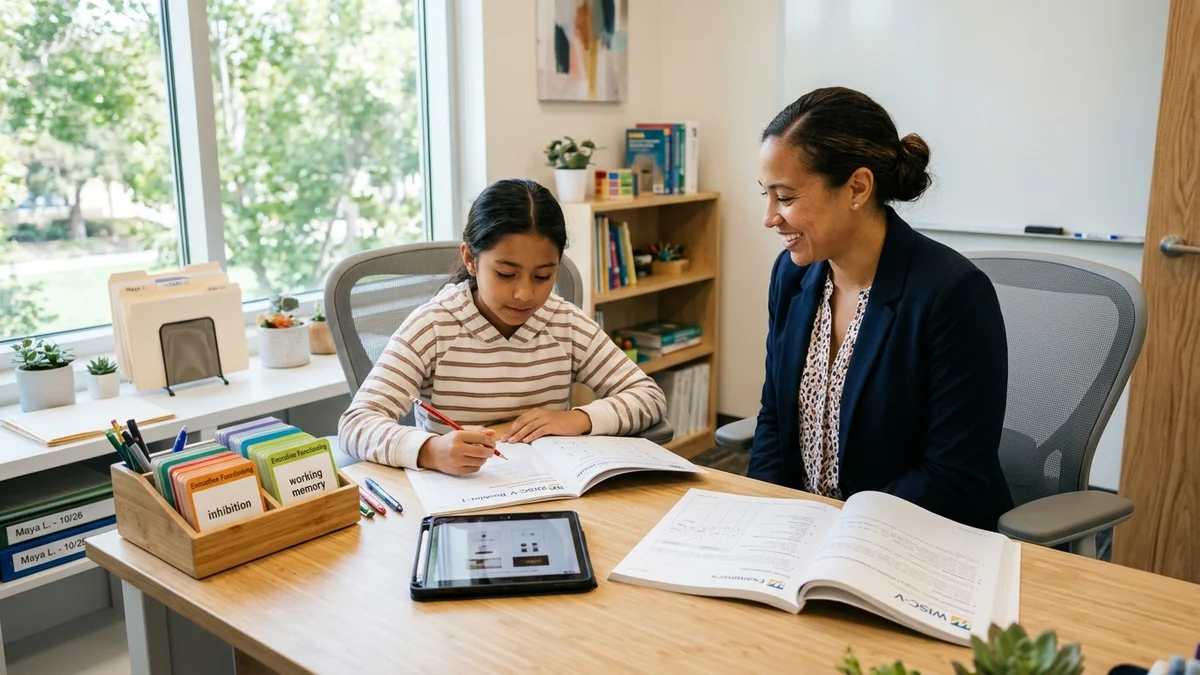
A legally defensible evaluation cannot rely on casual classroom impressions. Objective psychometric data must be gathered using gold-standard diagnostic instruments. In comprehensive independent evaluations, evaluators utilize specialized tools including:
Diagnostic Assessment Battery
Primary Instruments: Neuropsychological Assessment (NEPSY-II), D-KEFS, WISC-V Processing Speed & Working Memory, Post-Concussion Symptom Scale (PCSS). These specialized psychometric tests isolate neurocognitive, processing, and functional bottlenecks that standard district IQ tests completely miss.
Pediatric TBI and repeated concussions cause enduring disruptions in cognitive processing speed, neuro-fatigue, and emotional lability. An independent neuropsychological IEE establishes eligibility under TBI to mandate shortened days, cognitive rest, and modified curriculums.
3. Why District Assessments Fall Short
School district evaluation teams face immense administrative constraints. High psychologist caseloads, tight testing windows, and institutional pressure to limit expensive related services create systemic evaluation gaps:
- Superficial Testing Protocols: Administering abbreviated 4-subtest cognitive screeners that mask significant processing discrepancies.
- Ignoring Parent & Private Clinical Reports: Dismissing outside physician, neurologist, or pediatric therapist reports as "purely medical."
- Conflating Passing Grades with Lack of Need: Under 34 C.F.R. § 300.101(c), a child can have passing grades and still be eligible for special education if their disability requires accommodations or specialized instruction.
4. Exercising Your Right to an Independent Educational Evaluation (IEE)
If your child's school district conducted an evaluation that failed to diagnose, properly test, or provide necessary accommodations for Traumatic Brain Injury (TBI) & Post-Concussion Syndrome, you do not have to accept their conclusions.
Under California Education Code § 56329(b), you have the absolute right to send a written notice stating: "I disagree with the district's recent assessment and formally request an Independent Educational Evaluation (IEE) at public expense in all areas related to Traumatic Brain Injury (TBI) & Post-Concussion Syndrome."
Once requested, the school district must either fund the private evaluation with a certified independent evaluator (such as Donald Ghrist, M.S., LEP #2703 at CAS Evaluations) or immediately initiate a Due Process Hearing against you to defend their evaluation's adequacy.
Frequently Asked Questions (FAQ)
Does a concussion qualify a student for an IEP under Traumatic Brain Injury?
Yes. When post-concussion syndrome causes persisting neurocognitive deficits (memory impairment, rapid cognitive fatigue, light sensitivity, sensory overload), it qualifies under the federal TBI category (34 C.F.R. § 300.8(c)(12)).
Why do standard school psychoeducational evaluations miss TBI deficits?
School psychologists typically administer tests in quiet, distraction-free 1-on-1 rooms over multiple short sessions, which conceals the extreme cognitive fatigue and executive collapse that occurs in loud, continuous classrooms.
What accommodations are essential for a post-concussion IEP?
Key accommodations include planned rest breaks in a dark room, sunglasses/hats for fluorescent light sensitivity, audiobooks, reduced assignment volume, and exemption from high-stakes computer testing.
Can a student with a sports concussion get a shortened school day on their IEP?
Yes. If medical and neuropsychological data indicate that full-day attendance triggers severe headaches and cognitive regression, the IEP team must authorize a modified, shortened instructional day without academic penalty.
How does CAS Evaluations evaluate pediatric TBI?
CAS Evaluations conducts comprehensive neurodevelopmental assessments measuring processing speed under cognitive load, attention stamina, and working memory to build court-defensible IEP plans.